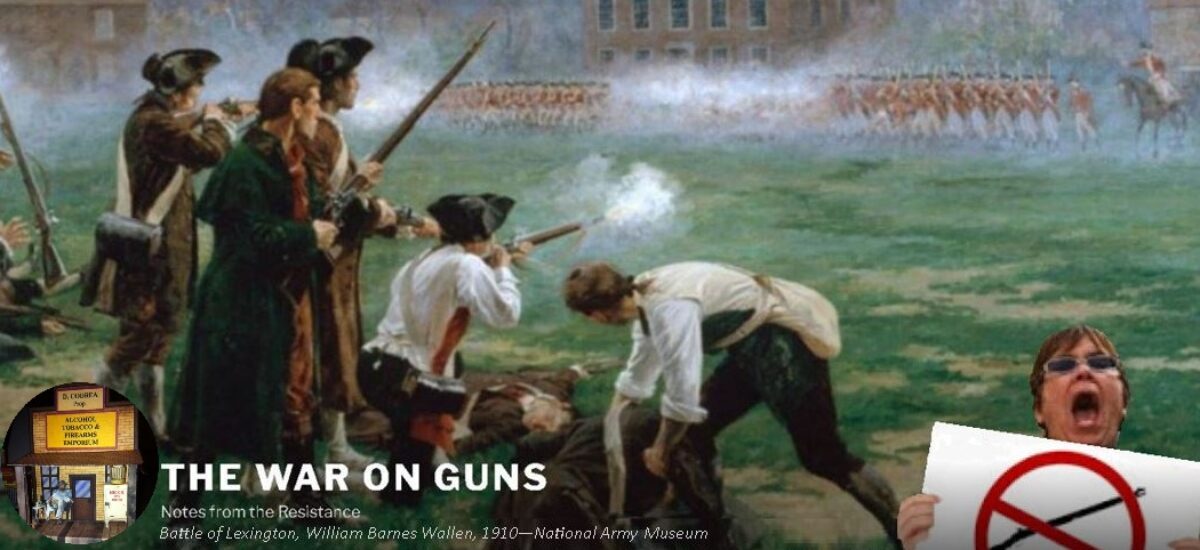
Gun rights groups frequently call on courts to exclude other time periods. That’s because there were fewer regulations — at least regulations written down as statute — compared to the latter half of the 1800s, leaving fewer historical analogues to pick from. Focusing on the Founding Era also ignores crucial legal developments in the intervening decades. [More]
Yeah, that’s because later infringements weren’t what was agreed to and ratified.
These creatures are such shameless f_ing liars.
[Via Michael G]






“Musket vs. AR-15: Judges Are Throwing Out Gun Restrictions Because of Antiquated Laws From America’s Founding”
One of those “antiquated laws” they’re all hot to get rid of is the Constitution of the United States of America.
1
?
The point of Bruen was to clarify Heller’s dicta on how federal courts were to judge 2nd Amendment cases; because, inferior court judges immediately ignored it by using interest balancing tests which aren’t in Heller. Justice Thomas being the 2nd Amendment authority on SCOTUS after Scalia’s death for many years had objected to lower courts paying lip service to Heller while using interest balancing and/or using a narrow definition of arms not that of Daniel Webster the founding era American lexicographer. It wasn’t until the 2021-2022 SCOTUS session that the text & historical traditionalist had a 6-3 majority so they didn’t have to worry that Kennedy or Roberts would side with the minority that a clean bearing arms case (NYSRPA v. Bruen) reached SCOTUS. It was the 1st clean case re. bearing arms outside the domicile when at least 4 justices believed that the majority will rule that governments can’t use discretion when regulating the people’s bearing arms outside the home. Justice Thomas had his chance to set the record strait on Heller. The Bruen opinion besides explicit setting out Heller’s 2 step review process also defines what “Arms” in “keep & bear arms” include besides bearable items used for offense and/or defense. (See pg. 19 of majority opinion: “Thus, even though the Second Amendment’s definition of “arms” is fixed according to its historical understanding, that general definition covers modern instruments that facilitate armed self-defense.” From Merriam Webster dictionary the definition of “facilitate” is: To make (something) easier. Therefore contrary to many judges and others firearms accessories like so called high capacity ammunition feeding devices, bump stocks, binary-triggers, forced reset triggers and suppressors are “Arms” per the 2nd Amendment. Per the explicit tests in Bruen the plaintiff challenging a restriction re. magazine capacity, devices that shortens the period between each operation of the trigger of a auto loading firearm only has to argue that the accessory being restricted “facilitates” armed self defense. Easy Peasy! The burden is on the state to defend the infringement by providing analogs from the federal period of history not including novel cases. In the case of Rahimi SCOTUS used historical laws that disarmed dangerous people unless they posted bond.
Re. State & federal law that restrict the 2nd Amendment rights of 18 through 20 year old ADULTS are clearly unconstitutional; because, historical tradition only includes two age groups, minors and adults. In 1792 the Militia act set the beginning age for adulthood as 18. There are no historical tradition for 3 age groups for constitutional rights.