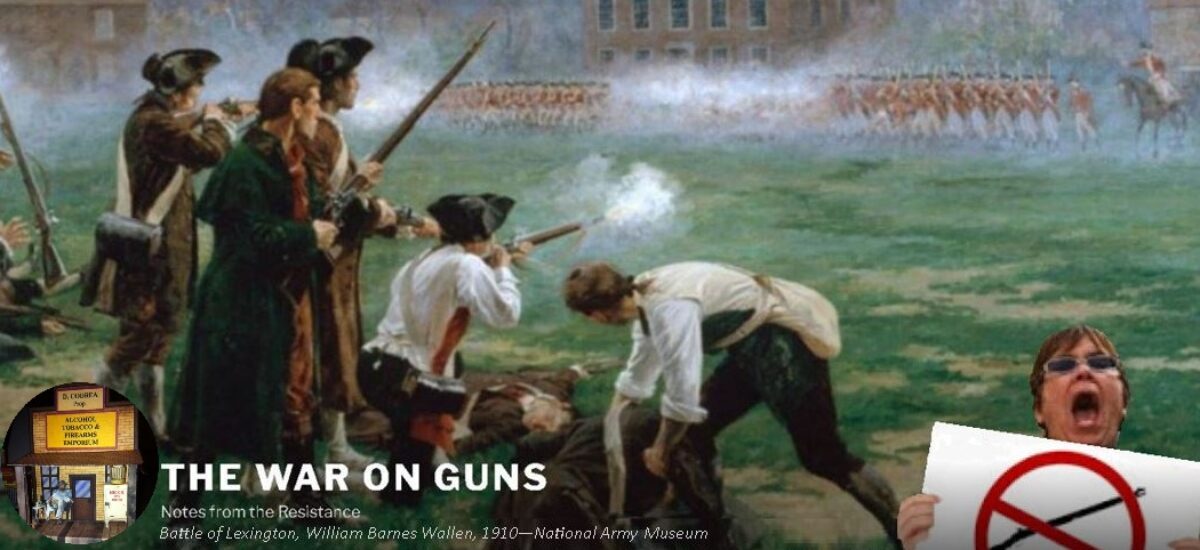
Chief Justice John Roberts Refuses to Clarify the “Historical Tradition” Test in Second Amendment Litigation [More]
Tag: Supreme Court
You’ll Get Your Day in Court?
For Reasons Best Known
Why the Supreme Court Keeps Rejecting Second Amendment Cases [More]
Me, I’m not automatically discounting more basic explanations…

[Via WiscoDave]
Silent Running
Attorneys for George Peterson have filed a petition for certiorari with the United States Supreme Court in Peterson v. United States, a Firearms Policy Coalition (FPC)-backed challenge to the federal government’s unconstitutional National Firearms Act (NFA) tax and registration requirements for suppressors. [More]
Now all SCOTUS has to do to let bad law stand is…nothing.
[Via Jess]
And All SCOTUS Has to Do to Encourage Others to Join In is Nothing
NSSF Petitions U.S. Supreme Court in NSSF v. James [More]
What’s stopping the court from doing the right thing?
[Via Jess]
Fair Weather Comrades
The rule is, if you side with us, we coddle you. Go against our pet projects—climate change, COVID policy, Obamacare, trans-weirdness of any kind, censorship of dis-, mis-, mal-information, etc.—and we try to destroy you. [More]
They actually take things beyond that– the goal is power, and in order to get it, the tool for outrage du jour is ignorable and expendable if it interferes with the greater agenda.
Once the Dictatorship of the Proletariat is established, who thinks the Bolsheviks won’t start culling Mensheviks?
Who thinks, once power is secured, the pronoun people won’t be the first to go?
[Via bondmen]
The Council of Damascus
SCOTUS Once Again Punts On Duncan v. Bonta [More]
Auda abu Tayi’s question about the Ruala comes to mind.
Insensitive Places
[A]s Bruen explained, larger, open places like cities, sidewalks, and parks cannot be considered sensitive places because it would effectively nullify the Second Amendment right to categorically exclude them from its coverage. [More]
Thanks for throwing your fellow gun-grabbers under the public transit bus!
Now acknowledge that even with closed space “protection,” “it’s”Only Ones” who claimed credit for stopping attacks have been reported to be hiding while a citizen subdued the attacker, and then there’s the not insignificant matter of making it to or from the “sensitive area” in one piece.
[Via Jess]
Common Law
And candidly, what you see in states such as Virginia and New Mexico and Colorado, the new Johnny come latelys, will not cease to stop until the United States Supreme Court finally shows it has a backbone, puts its foot down, and once and for all defends the common use doctrine. [Watch]
No post-’86 full autos or new technological developments exclusively reserved for the standing army for you, militia.
Avoiding the Issue
The Court selects what it will hear. It grants or denies petitions for writs of certiorari at its discretion. And although Supreme Court Rule 10 pretends to supply a neutral architecture for that discretion, the reality is that Rule 10 functions as a judicial escape hatch—a convenient justification for declining the very cases that demand intervention. In no domain is this more destructive than in Second Amendment litigation. [More]
Good article.
W appointee John Roberts is the biggest impediment, and it’s calculated.
Jeez, it’s almost like my concerns 20 years ago were legit.
As we’ve noted many times before, real recognition of the right to keep and bear arms won’t happen unless there’s a credible “or else” backing up the demand.
Speaking of Seditious Conspiracy…
It’s time to accept that the US supreme court is illegitimate and must be replaced [More]
Imagine what a state reconstituted in the image of what these Marxist ivory tower academics propose would do to you for not obeying its disarmament diktats.
Hey, you had your “fair trial,” citizen.
Does anyone capable of rational thought still believe the culture war is not existential?
‘AND TO KEEP AND CARRY ARMS WHEREVER THEY WENT’
This is a heck of a case. Watch this, because he does a good job explaining Gardner v Maryland, where a traveler forced to defend herself got hosed by Maryland violence monopolists..
I want to know why my A-rated Republican Ohio Attorney General Dave Yost did not join in with the other state AGs, and why my two A-rated Republican Senators, John Husted and Bernie Moreno, didn’t join in with Ted Cruz and all those other senators. I think I’ll ask them.
Also, in the briefs I’ve seen so far, there’s one case that’s not cited, and not being a lawyer that seems more than curious to me as it has direct bearing because it was decided by the Supreme Court.
In the infamous Dred Scott decision, SCOTUS made one admission that showed what the court’s thinking was on this exact issue when it rationalized:
“It would give to persons of the negro race, who were recognised as citizens in any one State of the Union, the right to enter every other State whenever they pleased, singly or in companies, without pass or passport, and without obstruction, to sojourn there as long as they pleased, to go where they pleased at every hour of the day or night without molestation, unless they committed some violation of law for which a white man would be punished; and it would give them the full liberty of speech in public and in private upon all subjects upon which its own citizens might speak; to hold public meetings upon political affairs, AND TO KEEP AND CARRY ARMS WHEREVER THEY WENT. [Emphasis added]
Educate a poor non-mouthpiece layman here who holds the simple notion that “shall not be infringed” means what it says and is jaded enough to believe the gun-grabbers understand that, too. Why isn’t anyone bringing up a part of Scott v Sandford that would survive where the rest of the decision would fall?
[Via Jess]
A Right Delayed AND Denied
And everything else is left hanging until whenever, with no rush there either.
As noted many times before, those who have it won’t cede real power unless there’s a credible “or else” attached to the demand. And they’re counting on most of us having too much to lose to jump out of the heating pot.
[Via Jess]
The SCOTUS Shuffle
SUPREME COURT Slams AR15 Case 2026 Gun Rights Status Check [Watch]
More balking around the edges when the true issue is invalidating NFA and all infringements, which won’t happen unless there’s a credible “or else” backing up the demand.
Wolford v. Lopez at a Glance
Sunlight for Vampires
…Hawaii’s law effectively negates the right to carry arms in public… [More]
Nice to see DOJ taking another step forward.
I’m also glad to see the word “bipolar” being used by influencers.
[Via Jess]
Hurry Up and Wait
Slaughterhouse Cases
It’s conference day today at the Supreme Court and instead of going live Monday morning to tell you all the bad news, we decided to give it to you ahead of time. Washington Gun Law President, William Kirk, discusses all 41 2A cases before SCOTUS on conference today so that you can understand the blood bath that will be Monday’s orders list. [Watch]
As noted before, all SCOTUS has to do to let bad law stand is…nothing, and real change won’t happen unless there’s a credible “or else” attached to the demands.
[Via Jess]
Merits Brief Informs SCOTUS on Hawaii’s ‘Vampire Rule’
Upholding Hawaii’s disarmament edict “fails every aspect of the analytical framework established by Bruen,” Beck and Petitioner Co-Counsel Mark W. Pennack argue. [More]
It’s difficult to conceive how the same court that gave us Bruen could agree that the Founders would have been cool with ubiquitous infringements.
One of Ours?
BREAKING! NEXT TRUMP SCOTUS JUSTICE FRONTRUNNER IS A HUGE GUN GUY! [Watch]
Will he answer some real questions?
Will he side with us against Bondi?
[Via Jess]